The Signature Edit
Why Your Signature Is Not Your Handwriting
Bad handwriting does not mean a bad signature. Here is why a signature is a designed gesture rather than a writing sample—and what that changes.
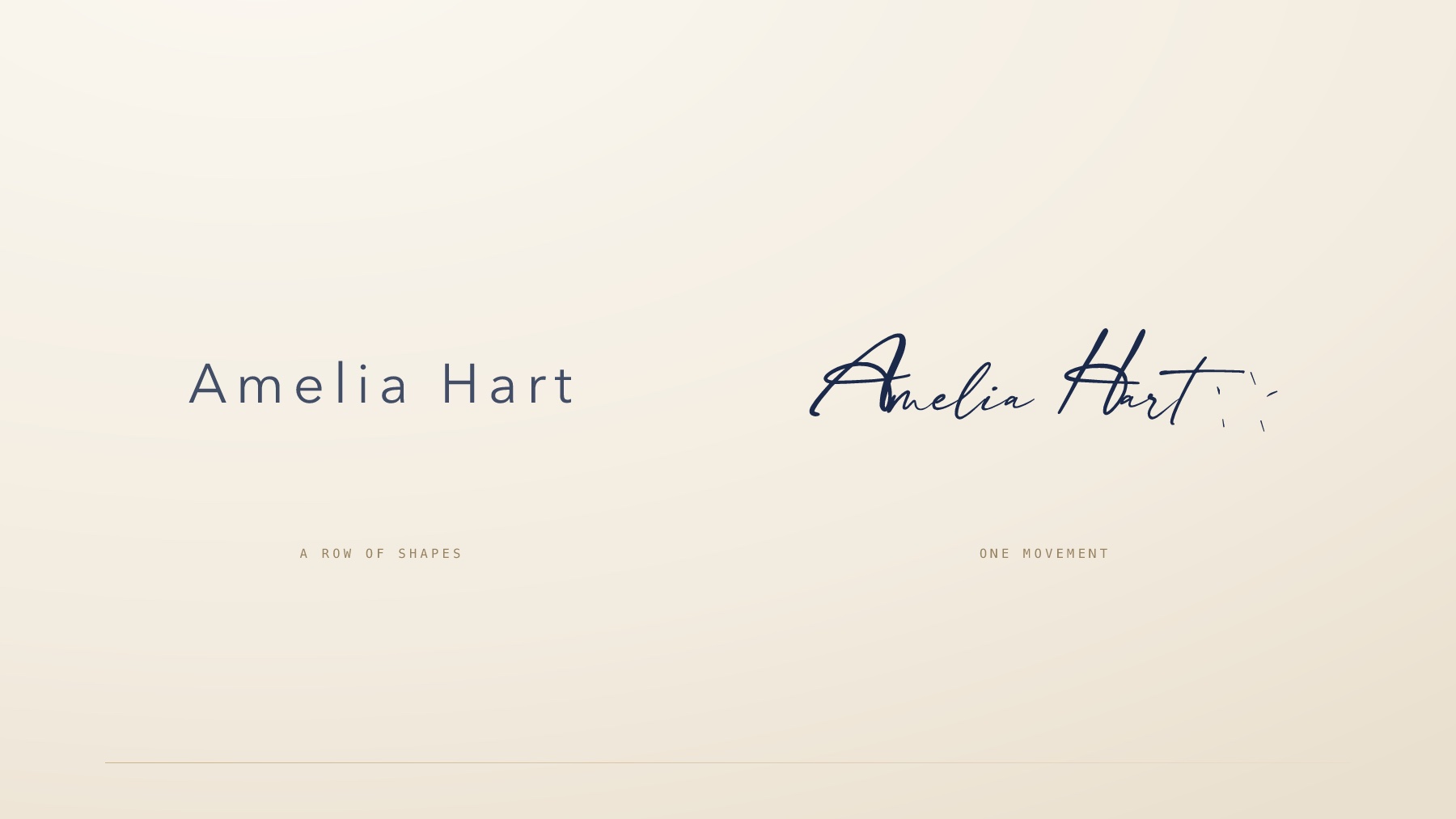
Most people who dislike their signature say the same thing first: my handwriting is terrible.
It is worth noticing how quickly that judgement arrives. Somewhere between a school exercise book and a stack of adult paperwork, a lot of us decided that our handwriting was a fixed personal trait—slightly embarrassing, not really fixable, and directly responsible for the scrawl we produce at the bottom of a form.
But a signature is not a handwriting sample. It is a much smaller, much more specific thing: one gesture, made from one name, repeated until it becomes familiar. Handwriting has to serve legibility across thousands of words. A signature has to serve recognition across one.
That difference is the whole opportunity. You can have ordinary handwriting and an excellent signature, because the two are doing different jobs.
Handwriting is a system; a signature is a single move
Handwriting is a general-purpose skill. It has to cope with every letter in the alphabet, in any order, at speed, often while you are thinking about something else. Its quality is judged by how easily someone else can read it.
A signature has none of those obligations. It is one fixed sequence you will make thousands of times in your life. It does not need to be read—it needs to be recognised. Nobody deciphers a signature letter by letter. They register a shape and match it against the shape they expect.
Handwriting is asked to communicate anything. A signature is asked to communicate one thing: this is me, and I meant it.
This is why practice works so differently for each. Improving your handwriting means retraining a broad habit. Improving your signature means learning one movement well. The second is a far smaller project than most people assume.
What actually makes a signature feel "bad"
When someone says their signature is bad, they usually mean one of a handful of specific things. It helps to name which one, because each has a different fix.
| What people say | What is usually happening | What actually helps |
|---|---|---|
| "My handwriting is messy" | The signature is being judged against printed text it was never meant to resemble. | Judge it as a mark, not as writing. Look at overall shape at arm's length. |
| "It looks childish" | The letterforms are still the ones taught in school, made one at a time. | Let the letters connect into a single movement rather than a row of shapes. |
| "It never looks the same twice" | Too many separate decisions to remember under pressure. | Reduce the number of deliberate details until the core gesture is stable. |
| "It looks like nothing" | No anchor—no initial, loop, or shape that carries identity. | Choose one feature to keep consistently and let the rest simplify. |
| "It looks like I'm trying too hard" | A flourish was added to compensate for an unresolved core line. | Fix the line first; add the finish last, if at all. |
None of these are handwriting problems. They are design problems, and design problems are solvable by making choices rather than by having better penmanship.
The evidence boundary worth keeping in mind
There is a long tradition of claiming that handwriting and signatures reveal character. It is worth being clear about where that stands.
Researchers have tested graphological assessments against standard personality measures and found no evidence validating handwriting analysis as a measure of personality, alongside very low agreement between graphologists evaluating the same samples.[1] A slant does not indicate confidence. An underline does not indicate ambition. A small signature does not indicate modesty.
What research does support is narrower and more interesting. In consumer psychology, the act of signing has been described as a general self-identity prime—signing can bring a sense of self to mind.[2] That is a statement about the act, not a diagnosis of the form. It says nothing about what your loops mean.
So the honest position is this: your signature does not reveal who you are. It is something you get to decide. That is a better deal than the alternative, because a reading you cannot change is far less useful than a choice you can make.
Three things you can change without changing your handwriting
1. The name you use
Before you touch a single stroke, decide what the signature is made of. Full name, first name, initials, or a hybrid of an expressive first name and a structured surname—each produces a different mark from exactly the same hand.
This is a content decision, not a skill decision. Someone with shaky handwriting and a strong first initial may be far better served by a compact initial-led mark than by a full name they have to fight through.
2. The number of pen lifts
Count how many times your pen leaves the paper during your current signature. For many people the answer is five or six: a capital, a cluster of letters, a dot, a crossing stroke, a surname, an underline.
Every lift is a place where the mark can wobble, and a place where a rushed version diverges from a careful one. Reducing lifts is the single most reliable way to make a signature more consistent, and it requires no improvement in handwriting at all—only a decision about where the line continues.
3. The finish
The last movement disproportionately shapes how a signature reads. A line that stops cleanly feels composed. A line that trails away feels open. A line that loops back under the name feels deliberate.
Whatever you choose, choose it once. A finish that changes every time is the detail most likely to make a signature feel unreliable.
An exercise: separate the two skills
Take a sheet of paper and draw a line down the middle.
On the left, write a full sentence in your normal handwriting—anything, a line from an email you sent this morning. On the right, write only your signature, six times.
Now look at the two columns as if they belonged to different people, because in a sense they do. The left column is a system under load. The right column is one gesture with six attempts to settle.
Ask three questions about the right column only:
- Which version would you be happy to see at the bottom of a proposal?
- What is present in every single attempt, even the worst one?
- What appears in some attempts and not others?
The thing present in all six is your anchor—the part of the mark your hand already knows. The things that come and go are candidates for removal. Neither answer has anything to do with the sentence on the left.
A designed gesture, not a verdict
There is a quiet relief in realising that your signature is not a report card on your handwriting. It is not evidence submitted about your character. It is a small piece of personal design that you are allowed to revise.
Plenty of people with beautiful handwriting have forgettable signatures. Plenty of people who apologise for their handwriting have marks that are immediately, unmistakably theirs. The difference is almost never penmanship. It is whether anyone ever made a decision.
You can make that decision this week. One name, one anchor, one movement you can repeat—and a handwriting habit that stays exactly as it is.
Continue reading: What Signature Psychology Can—and Cannot—Tell You and How to Design a Signature You Can Actually Repeat.