The Signature Edit
Cursive Is Back in School: What It Will and Will Not Do for a Signature
New Jersey and Pennsylvania now require cursive instruction, and lawmakers keep citing the signature. What cursive will give a child's signature, and what it will not.
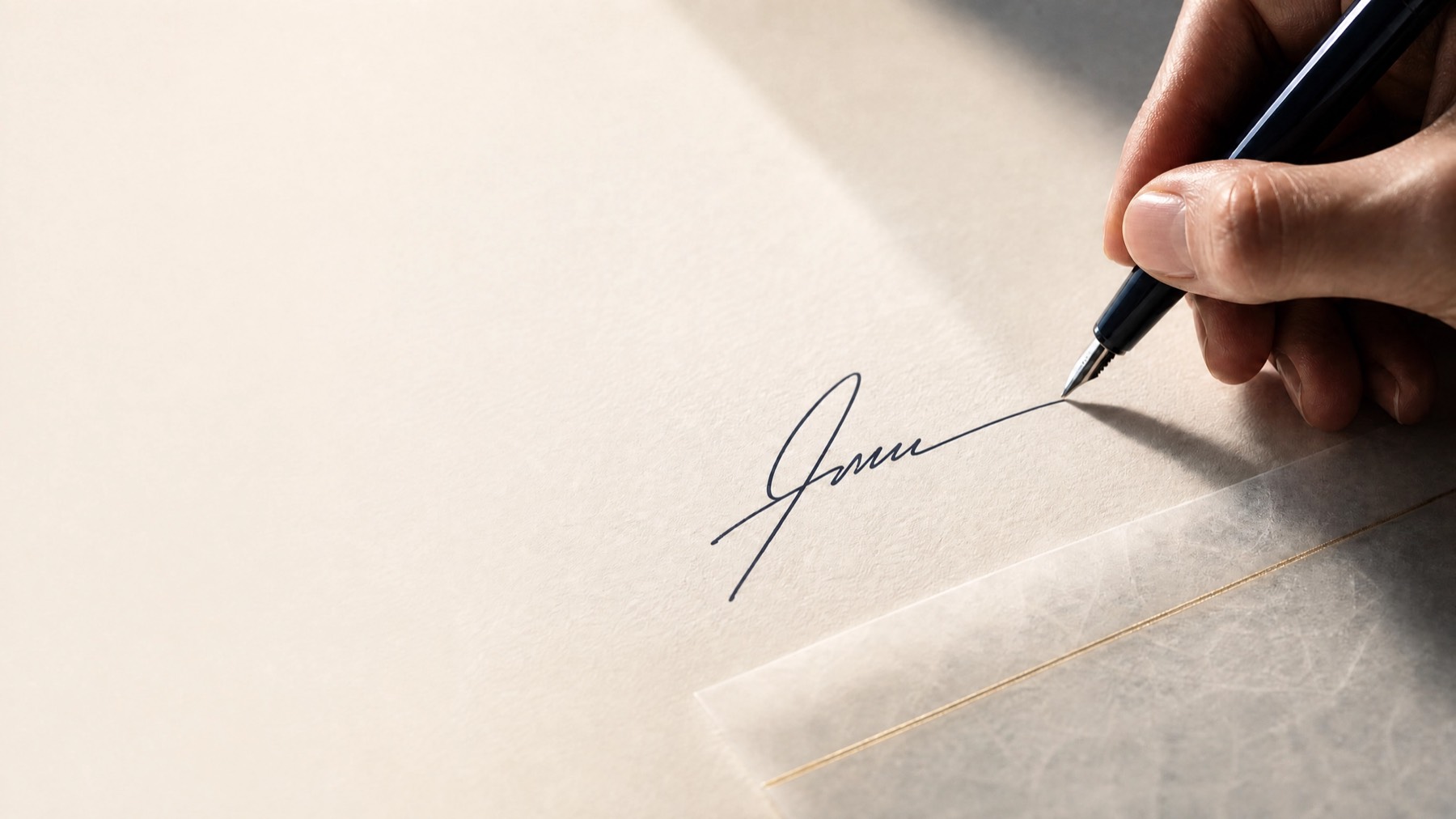
This fall, third graders across New Jersey are learning to join their letters again. A law signed in January requires every public school in the state to teach cursive in grades three through five, starting with the 2026–27 school year, so that children finish fifth grade able to read and legibly write it. Pennsylvania's Act 2 of 2026, in effect since April, adds printing, joined italics, and cursive to the state's school code. By most counts, at least half of US states now have some kind of cursive requirement, close to double the number a decade ago.
Read the coverage and one reason comes up again and again: the signature. Children need cursive, the argument goes, so they can sign their own names. Some lawmakers go a step further and say a cursive signature is more secure than a printed one.
We spend our days thinking about signatures, so it seemed worth asking plainly: what will a few years of cursive actually do for the way a child signs, and what is it being asked to do that it cannot?
What cursive genuinely gives a hand
Start with the part that is true, because there is a lot of it.
A connected stroke. Cursive teaches the hand to keep moving between letters. That habit is the raw material of almost every adult signature. Most signatures are not cursive in any textbook sense, but they are joined: an entry, a run, an exit, with few lifts. A hand that has practiced joining has a head start on making a mark it can repeat.
A set of capitals to borrow from. The capital letter does most of the work in a signature. Cursive instruction hands children a full alphabet of capitals with built-in entry strokes and loops. Many of them will end up editing those capitals, or abandoning them, but they will have something to edit. A child who has only ever printed tends to sign by printing faster, which is a harder starting point.
Rhythm. Repeated letter drills are, among other things, rhythm practice. Rhythm is what makes a signature look like the same signature on Monday and on Friday, and it is the quality people mean when they say a mark looks confident. It is a motor habit, not a personality reading, and it can be taught.
Reading the past. The other half of the New Jersey law, often overlooked, is reading. Letters from grandparents, old deeds, census records, the founding documents in a school textbook: a lot of the written record is in script. That has nothing to do with signing, and it may be the strongest argument of all.
None of this is controversial. If your child comes home with a page of looped capital Fs, they are learning something real.
What cursive is being asked to do that it cannot
"A cursive signature is more secure"
This is the claim to slow down on. It sounds intuitive: joined letters look harder to copy than printed ones. But what makes a signature count on a lease, a loan, or a permission slip is not the shape of the letters. It is the process around it: who watched you sign, what record was kept, what identity check came first, and whether you can later show that the act was yours.
A carefully looped signature can be traced in a minute. A scrawl can be imitated by anyone who has seen it twice. Complexity is a cost you pay every time you sign, and it buys very little protection. If security is the goal, it lives in the procedure, not the penmanship.
That does not make the law wrong. It makes this particular reason weaker than it sounds.
"Kids need cursive to sign their names"
They need a signature. They do not need it to be cursive. Signatures in the wild include printed names, initials, a capital and a line, and marks in scripts that have no cursive tradition at all. A valid signature is about intent and process, and requirements vary by context and location, but nowhere we know of is the signature itself graded on letterforms.
What school can usefully give a child is fluency: a hand that moves easily enough that signing does not feel like a test. Cursive is one good route to that. It is not the only one.
"Cursive shows character"
You will not find this in the laws, but you will hear it at dinner tables. Neat, flowing handwriting signals a disciplined child; a messy hand signals a careless one. This is graphology in a school uniform, and the evidence does not support it. Handwriting analysis has been tested against personality measures many times and has not held up. A signature reflects training, tools, speed, and habit. It does not reveal a temperament. A child who struggles with loops is a child still learning loops.
Cursive can teach a hand to move. It cannot teach a signature to mean anything the hand did not decide.
The signature they will actually keep
Here is the part that gets left out of the debate. Almost nobody keeps the signature they were taught.
Most adults can point to the moment their school signature started to drift: a first job, a first credit card, a first lease, the thousandth time signing a delivery tablet. The textbook capital gets simplified. The middle letters collapse into a run. A lift disappears. By thirty, most signatures are a personal edit of whatever the hand was given, and that edit is mostly unconscious.
That is not a failure of the curriculum. It is how signatures work. A signature is a habit that settles under real conditions, which is why your adult signature is not your handwriting. It is a short, practiced gesture that has drifted away from the alphabet it came from.
So the most useful thing cursive can do is not to fix a child's signature for life. It is to give them good material for the edit they will make anyway.
If you have a child learning cursive this year
A few low-pressure things help more than drills.
Let them sign things that matter to them. A drawing, a birthday card, a library card. Signing is a different act from writing, and children notice the difference when the paper is theirs.
Do not correct the signature like homework. Correct the letter practice, by all means. But when they sign their name, ask which capital they like, not whether it matches the chart.
Show them more than one model. Their own name in printed capitals, in joined script, as initials. A signature is a choice among formats, and knowing there is a choice is half the skill.
Leave legibility as a dial, not a rule. Some contexts want a readable name; some do not. A child who learns that early will make better decisions at nineteen than one who learns that a signature is a spelling test.
If you never learned it, or lost it
Plenty of adults finished school just as cursive was dropped, or printed their way through and never looked back. Some feel faintly embarrassed about it now that the subject is in the news.
There is no need. You do not have to learn cursive to have a good signature. You need three things: an entry you like, a body your hand can repeat at speed, and an exit that tells you the mark is done. Those can come from printed capitals, from a single initial and a line, or from a joined script you learn at forty because you want to. If you do want to borrow from cursive, borrow selectively: one capital, one join, one exit. You are editing, not starting over.
And if your school signature is still with you, half outgrown, you can design a new one you can actually repeat. Hands learn at any age.
The good news in the news
It is easy to be cynical about a curriculum change dressed up with security claims. We would rather be glad about it. A generation of children will get more practice moving a pen, more capitals to choose from, and the ability to read their great-grandparents' letters. Those are real gifts.
Just keep the signature in proportion. Cursive gives a child a starting alphabet. The signature they keep will be the one they edit, through use, into something that feels like theirs. That part was never going to be on the curriculum.
Continue reading: Why Your Signature Is Not Your Handwriting and How to Design a Signature You Can Actually Repeat.
Sources: New Jersey Department of Education, Cursive Handwriting Act; The 74, "Cursive Handwriting Is Set for a Comeback in Pennsylvania Schools" (February 19, 2026); Zaner-Bloser, "Which States Have Cursive Handwriting Laws" (March 2026).