The Signature Edit
Save the Date: Your Names, in Your Own Hands
Skip the script font. How a couple puts both real signatures on a save the date: one mark each, sizing two hands to sit together, the ampersand, and clean files for print and screen.
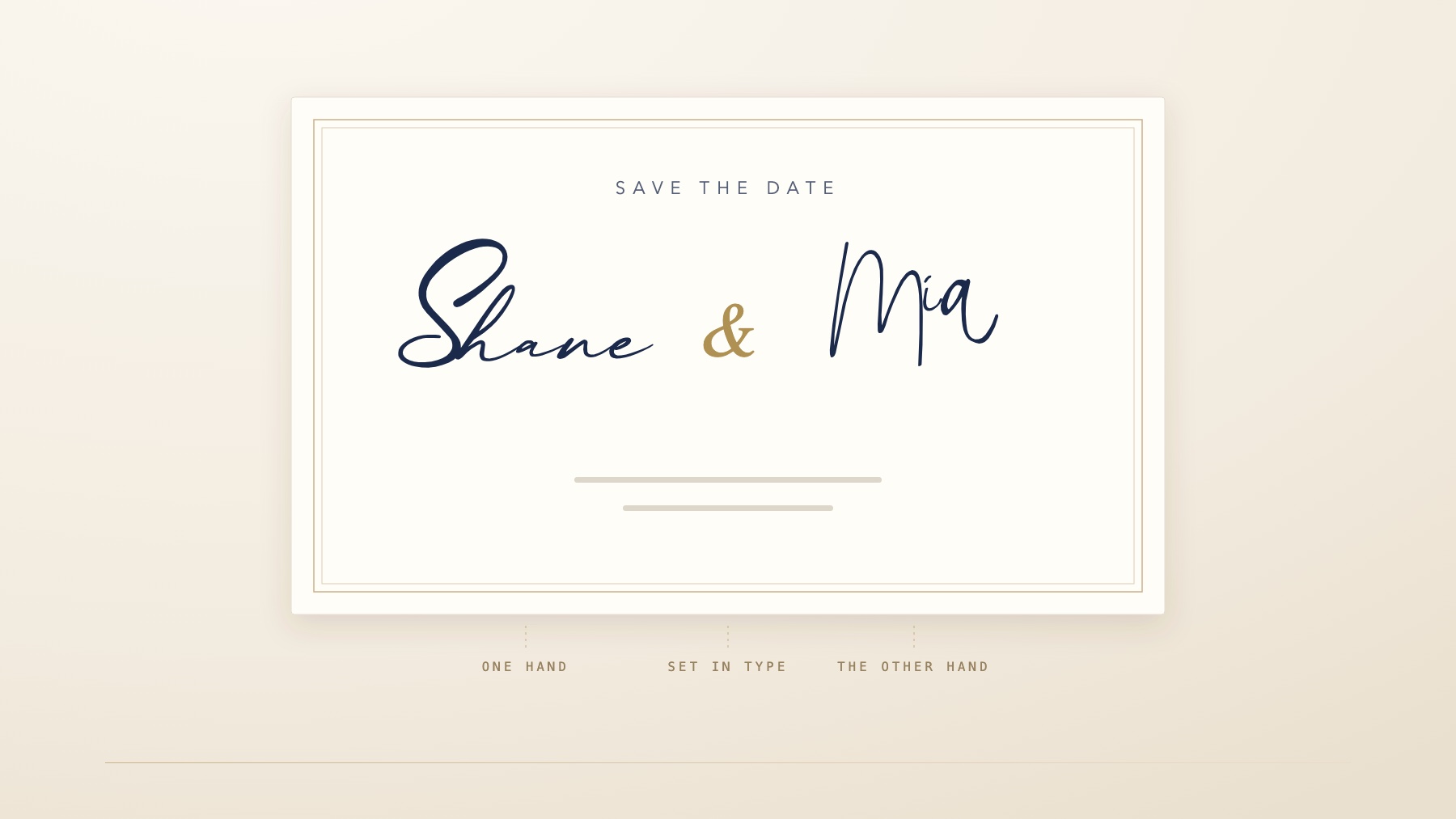
The save the date is the first piece of your wedding that most guests will hold. It arrives months ahead and goes on a refrigerator, and on it, nearly always, are your two first names set in a script font.
The script font is lovely. It is also the same script font on a great many other refrigerators. Stationery templates draw on a fairly small set of wedding scripts, so the flourish under your names may well match the one under your cousin's names from two summers ago.
There is a simple alternative that costs nothing and that nobody else can copy: put your names on the card in your own hands. Each of you signs, and the card carries two real signatures with an ampersand between them.
This is a short guide to doing that well.
Why your own hands, and what they do not say
A handwritten name on a printed card tells the people who know you that you two made this. Your aunt knows your signature from twenty birthday cards, and your college roommate knows the way you cross a capital. That recognition is the whole effect, and it is a real one.
It is worth being clear about what the signatures do not do. They do not reveal what kind of couple you are. A flowing signature does not mean a romantic partner, and a compact one does not mean a guarded partner. Handwriting analysis has been tested against personality measures many times and has not held up, and what signature psychology can and cannot tell you is a short list. Your signatures on the card mean "we were here, and we meant this." That is enough for a save the date.
One mark each
The rule that settles most of the decisions is simple. Each name is written by the person it belongs to.
A card with both names in one partner's handwriting is perfectly friendly, but it is that partner's card. The point of using signatures rather than a font is that there are two of you, and the card shows it. If one of you has a tidy hand and the other signs like a seismograph, keep both. The difference is the point.
This also means neither of you should design the other's signature. You can sit at the same table, compare, and suggest, but each person settles their own mark. A signature someone else drew for you is a label with your name on it.
Making two hands sit together
Two signatures made separately rarely sit well side by side on the first try. One is usually bigger, slants more, or trails a longer exit stroke. A few small adjustments fix most of it.
Match the visual size, not the letter count. A short name with a large capital can look as heavy as a long name signed small. Put the two signatures next to each other and scale them until neither one dominates. Usually that means bringing the larger one down rather than blowing the smaller one up, because enlarged signatures show every wobble.
Share a baseline. Signatures wander up and down. Line up the bodies of the two names, the part after the capital, rather than the tops of the capitals. Capitals can rise as high as they like.
Stack or run. Two names on one line read as a pair. Two names stacked, one above the other, read as a monogram with room to breathe, which works well on a tall card or a phone screen. Long names usually stack better.
Let exits run out. If a signature ends in a long tail, give it space instead of trimming it. The tail is part of the mark. Move the ampersand or the second name instead.
The ampersand
The ampersand between two signatures belongs to neither of you, so you are free to set it in type rather than drawing it. That is often the best choice. A single typeset ampersand in an italic serif, perhaps in the accent color of your stationery, ties the two hands together without adding a third.
If you would rather write it, the second signer writes it, in the same pen, as part of their signature. Practice it until one form sticks. An ampersand that looks different each time reads as a mistake on a card that will be printed a hundred times.
Whatever you choose, use it everywhere: the save the date, the invitation, the thank-you cards. That set of marks is your wedding's monogram now.
Which names to sign
Sign with the names you use today. A save the date goes out months before the wedding, and if one of you plans to change a name, the change has not happened yet. Signing a name you do not use is a strange thing to print.
Most couples sign first names only, which is right for the card. If a name change is coming, it is a good time to think about the signature that goes with it, and we have written about what to do with your signature when your name changes. There is no rush. The thank-you cards are a fine place to debut it.
Getting marks clean enough to print
Stationery printers need artwork, not a photo of a napkin. Here is the simplest route.
- Sign on plain white paper with a black felt-tip or gel pen. A ballpoint skips and goes gray when scanned. Use the pen you would actually sign with, not a calligraphy nib you met this morning.
- Sign each name ten or twenty times. Do not sign slowly to make it neat. Sign at your normal speed, then pick the best one. A signature written carefully looks traced.
- Scan at 600 dpi, or photograph flat in daylight. No shadows from your phone, no flash.
- Cut each signature out on a transparent background and send the printer a vector file (SVG or PDF) if they accept one, or a high-resolution PNG if not.
- Proof at actual size. Print the card at home before you approve it. A signature that looks elegant on a monitor can look thin at three inches wide.
If you would rather start from a designed version of your own signature, the same rules apply. It has to be yours, it has to be one you can actually repeat, and each of you makes your own. Our guide to designing a signature you can actually repeat covers that.
On screen
More save the dates go out digitally now: an email, a wedding site, a short video for the group chat. Real signatures work well there, and on screen they can do something print cannot. They can be written out stroke by stroke as the card opens, in the order each of you would write them.
Keep it to the names. Animating the whole card at once turns a keepsake into a screensaver. One motion, the two names arriving in your two hands, is the moment people remember.
And make sure the still frame works. Many people will see only the thumbnail, so the first frame should already show both names in full.
What the signature on a save the date is not
It is artwork, not a legal signature. You are not agreeing to anything by putting your name on a card, and the version you print does not need to match the one at the bank. It only needs to be yours, and to look like you to the people who will put it on the refrigerator.
Continue reading: How to Design a Signature You Can Actually Repeat and What to Do With Your Signature When Your Name Changes.