The Signature Edit
What to Do With Your Signature When Your Name Changes
Marriage, divorce, transition, or a return to a family name—here is a calm, practical way to redesign a signature when the name itself has changed.
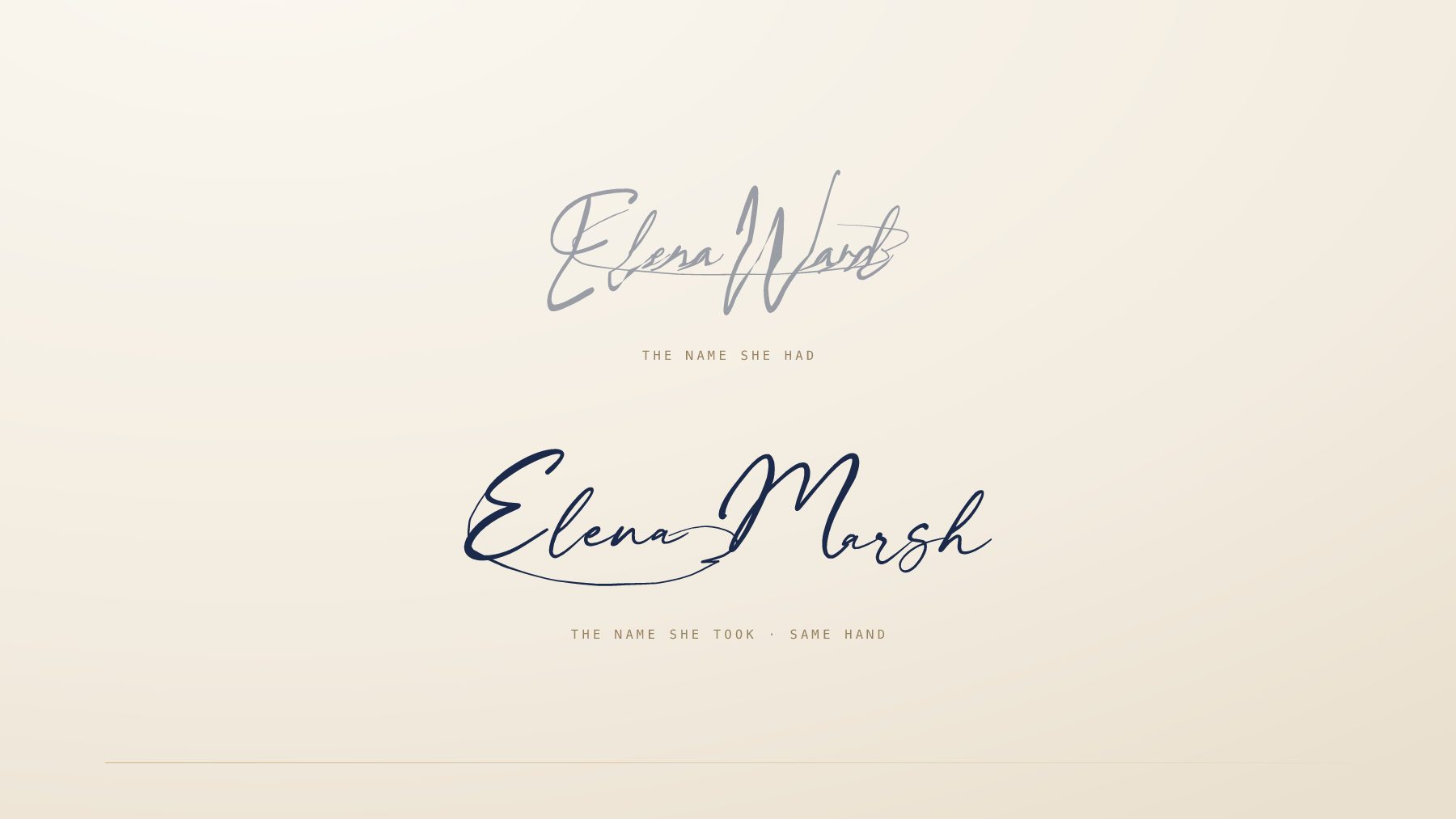
A name change is administrative for about a week and personal for much longer.
The paperwork has a clear order to it: the deed or certificate, then the passport, then the bank, then the twenty smaller accounts that surface over the following year. The signature is the item nobody schedules. It just turns up—at a counter, on a form, in a moment when you have to produce a version of a name your hand has never written before, and what comes out looks like a first attempt, because it is.
Whether the change comes from marriage, divorce, transition, adoption, naturalization, or simply a decision to use the name you should have been using all along, the signature is one of the few parts of the process you get to design rather than submit. That is worth taking a little time over.
Give yourself permission for a transition period
The first thing to know is that the wobble is normal and temporary.
Your old signature was a motor habit built over decades. The new one is a fortnight old. For a while, your hand will start the old movement before you catch it, particularly when you are distracted or signing at speed. This is not a sign that the new name does not fit. It is the same adjustment anyone makes when learning any new signature—it simply arrives with more feeling attached.
A signature is a habit before it is a statement. Habits take a few weeks, regardless of how certain the decision was.
Practically, expect two to four weeks of deliberate signing before the new mark becomes automatic. During that period, sign a little more slowly than usual on anything that matters, and do not be alarmed by inconsistency between versions.
Decide how much continuity you want
This is the real design question, and it is a personal one rather than a technical one. Some people want the new signature to feel like a continuation of who they have been. Others want a clean break—a mark with nothing carried over.
Both are entirely reasonable. It helps to choose deliberately rather than by default.
| Approach | What it looks like | Suits |
|---|---|---|
| Full continuity | Keep the first name exactly as it was; rebuild only the surname in the same rhythm and slant. | A change that adds to an identity rather than replacing it |
| Partial continuity | Keep one element—the slant, the finish, the opening gesture—and let everything else be new. | Wanting recognizable continuity without preserving the old mark |
| Clean break | Design the whole mark from scratch, including the parts that could have carried over. | A change that marks a genuine boundary |
| Return to a previous mark | Recover an earlier signature, often a pre-marriage one, and update it. | Reverting to a former name |
There is no correct answer, and no one else needs to understand the reasoning. A signature is one of the very few identity documents whose design is entirely yours.
If you are reverting to a former name
You may find the old signature comes back quickly—motor patterns persist for years. That can be welcome or unwelcome, and it is fine to want an updated version rather than the one you used at twenty-three.
Treat the returning mark as a starting point, not an obligation. Keep the parts you still like, and let the rest reflect the fact that a lot of time has passed.
If the change is part of a transition
The signature is often one of the more meaningful small steps, and there is no need to rush it. Some people find it helpful to practice the new mark privately for some weeks before it appears on anything official—a low-stakes way to let it become familiar before it becomes public.
If you also want the mark to feel less tied to the letterforms you were taught as a child, this is a reasonable moment to reconsider slant, size, and register alongside the letters themselves.
Practical points worth knowing
A few things people ask, kept plain.
Signatures do not have to be legible, or match a previous one. A signature is generally a personal mark of assent rather than a controlled specimen. That said, institutions maintain their own records: banks, notaries, and some official processes hold a specimen on file and may ask you to update it. The sensible move is to settle the new mark first, then update those records once, rather than filing three different versions over a month.
Expect an overlap period. Documents signed in the old name before the change remain valid; you are not obliged to re-sign history. Where an institution needs to link the two, that is what the change-of-name document is for.
Requirements vary. What a bank, a registry, or an employer asks for differs by country and by institution. Where something matters legally, check with the organization concerned rather than assuming a general rule applies.
An exercise for the in-between
If the change is recent, or still ahead of you, try this before committing.
Write the new name ten times in your ordinary handwriting—not as a signature, just as writing. The aim is to get past the strangeness of the letters themselves. Notice which combinations your hand finds easy and which ones it stumbles over. A new surname often contains a letter pairing you have simply never written before.
Now write it ten more times as a signature, quickly, without correcting. Look at the sheet as a whole.
Ask: what came out of my hand that I did not plan? There is usually something—a connection between two letters, a way the new initial wants to open, a finish that appears on its own. That unplanned thing is often the best part of the new mark, because it came from the way you already move rather than from a decision you made about how you ought to look.
A name you chose deserves a mark you chose
Most people never design their signature. They inherit one from whoever they were at eighteen, and it follows them for forty years without ever being reconsidered.
A name change removes that default. The old mark no longer applies, and something has to take its place. That is an unusual position to be in, and a genuinely good one: you get to decide, with adult judgment, what your name looks like when you write it.
Take the fortnight. Write it badly for a while. Then let it settle into something that feels less like paperwork and more like yours.
Continue reading: How to Design a Signature You Can Actually Repeat and Why Your Signature Is Not Your Handwriting. If the new name is already yours, the studio will draw it: a signature for a new last name.